

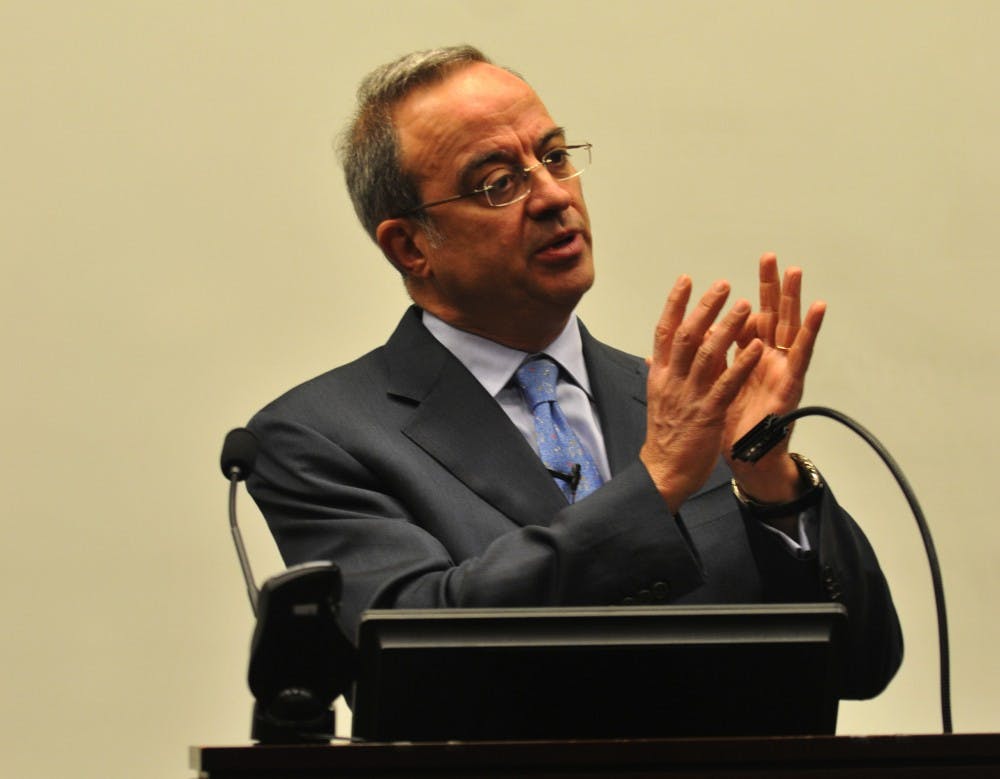
Marwan Muasher speaks to students on Arab Spring

Speaker reflects on revolutions one year later, offering new perspectives

· February 23, 2012, 12:31 am

Share This

Maegan Cadet | DP

Former Jordanian Deupty Prime Minister Marwan Muasher speaks at Gittis Hall. He discussed the complexity in Middle East politics and relations.


According to one expert, the Arab Spring is set to spring on indefinitely.

On Wednesday evening, the Law School hosted Marwan Muasher to speak on “The Arab Awakening: One Year On.” Muasher’s career has spanned stints with the Jordanian ministry, diplomatic service and the World Bank. He played a role in developing the Arab Peace Initiative and the Middle East Road Map.

The talk drew a crowd of 90 with representation from several Penn professional, graduate and undergraduate schools. Law student Eric Lorber, president of the National Security Society, which sponsored the event, said the group was interested in bringing Muasher and other “players in the field” to Penn to provide expert insight on developments in the Arab world.

For Jim McGann, assistant director of the International Relations program, “any effort to bring a greater understanding of these dramatic events is critical.”

In prepared remarks, Muasher touched upon a variety of Middle East topics. He began by renaming the Arab Spring, calling it an “Arab Awakening,” and said that Islamic regimes are losing popularity. Parties with plans for institutionalizing economic advancement through political reform will succeed, Muasher said. Newer leaders will also improve education because, Muasher said, “Teaching people to think critically might give you headaches, but headaches are better than revolutions.”

Speaking on the ongoing Arab-Israeli conflict, Muasher claimed that the Israeli government must accept a two-state solution now or make larger concessions later. He cited Israeli government findings that there are equal numbers of Jews and Arabs in the country, but, in his opinion, higher Arab birthrates will cause Israel to lose its character as a Jewish state.

Using vivid imagery, he described the Arab world as a “burning building.” The region’s old political structures cannot outlast ongoing democratization, Muasher said. Arab officials who one year ago had publicly ridiculed hopes for democratic uprisings are “silent today,” he said.

Assuring listeners of his realism, Muasher concluded with an image of the future Arab world as “pluralistic and prosperous,” embracing ethnic and political diversity.

Many attendees expressed profound personal interest in the talk’s content. “I was in Israel during the Syrian uprising and the Libyan Civil War. I lived near the Jordanian border and saw events firsthand,” said College freshman Josh Spector, who attended the talk to get a “different, deeper perspective on the politics of the Arab Spring.”

The speaker’s views were “not a position many of us had considered before,” said Lorder.

For Penn Law Associate Dean for International Affairs Amy Gadsden, Muasher’s talk was an “opportunity to reflect upon events in the year past and think about the road forward.”


Comments (4)

Karl the Hun

February 23, 2012, 11:28 am

Flag this comment

I attended Mr.Muaher’s talk at the Law School and heard every word he said. Mr. Rosa’s article is mis-leading. In the actual talk (although he may have said it in a private conversation }, Mr. Muasher said nothing about Israeli or “Palestinian” Arab birthrates at all.He merely ( inaccurately } claimed there were equal numbers of Arabs and Jews west of the Jordan River and that the possibilities of the “so-called Two State solution” is eroding day-by-day without explicitly saying why. He said nothing about Israel needing to make “larger concessions later.” What he said that if the Arabs under what he called “the occupation” do not achieve equal rights where they are living (ie Gaza and Judea and Samaria(aka “the West Bank”) they will demand to be citizens of the State of Israel. He thus implied , but did not explicitly state the so-called “One State solution.” otherwise he explicitly did say Israel would face a dilemma in being both Jewish and democratic. He said nothing directly about negotiations although he did say, “ I believe in peace.” He did write about his ideas and his experience of being Jordan’s first ambassador to Israel in his book “The Arab Center.”

Karl the Hun

February 23, 2012, 12:12 pm

Flag this comment

The following will be MY analysis not Mr. Muasher’s. First of all his population figures of the Arab population are inflated. Second the Arab birth-rate is falling and the Israeli Jewish birth-rate is rising. In any case there is a difference between Arabs living in the West Bank and those Arab-Israelis living in pre-1967 Israel.Arab citizens of Israel have equal rights and full citizenship most of those in the West Bank are now under the jurisdiction of the Palestinian Authority. They are NOT part of any so-called “demographic danger” to Israel itself: so their exact numbers do not matter as far as Israel’s democracy; theoretically they have democratic rights to elect their own Palestinian Authority leaders. See Daniel Gordis’ book “saving Israel.” Basically Israel is a Jewish state because of what iT is. The Mandate Treaty basically established Israel as a “Jewish National Home “ under International Law—Still in force under Article 80 of the United Nations Charter. Os the Jewish State vs. democracy issue is false and has nothing to do with the status of Judea and Samaria.

Karl the Hun

February 23, 2012, 5:36 pm

Flag this comment

Also there is no “two State solution” to “accept” anyway. The PLO ,anti-Israel writers claim The PlO and writers like Rhashid Khalidi claim the PLO accepted two states for two peoples in 1988, but the two states they accepted were Palestine and Jordan for the “two fraternal peoples” Palestinians and Jordanians. Also The PlO and the PA are now part of some united government with the Hamas terror organization in violation of EVERY aspect of the Oslo accords so negotiations have stopped. It also makes no sense to sign new agreements when the Pa/Fatah etc. will just violate them anyway. the PA and Fatah and PFLP have said hundreds of times they will never accept Israel as a Jewish State. The Arab Peace Initiative aka the Beirut or Saudi Arabian Peace Initiative Mr. Moasher was involved with is a total non-starter — Israel cannot accept it or even use it as a basis of negotiation because to do so would immediately destroy Israel’s sovereignty on the West Bank, and it would be suicide to accept its provisions about the “Palestinian right of Return.” It also would imply Israel’s right to exist depends on some sort of Arab acceptance undermining Israel’s basis based on the Balfour Declaration, The San Remo treaty and the Mandate Treaty all still in force. Unfortunately Mr.Muasher (sorry for mis-spelling his name above I just noticed) did not go into the very complex implications of the Arab Peace Initiative or Explain EXACTLY what it means; that would have been extremely helpful.

Karl the Hun

February 25, 2012, 5:10 pm

Flag this comment

I find it a little strange for Mr. Muasher to wax so eloquently yet in such a high handed manner about the Arab-Israel conflict and how it should be “resolved” etc. without talking about the actions or should I say atrocities of the country he represents. I’m talking about how after the 1948 war when Trans-Jordan ( shortly to become Jordan after they illegally annexed what became the West Bank that was not recognized by anyone except the UK and Pakistan) BURNED and destroyed the entire Jewish Quarter of Jerusalem destroying many synagogues, used ancient Jewish tomb-stones as material to build latrines and roads in the Mount of Olives. How come no one at the lecture questioned him on this? So where does he get off so high and mighty preaching about what Israel should do? Turn it over to the “Palestinians” so they can do the same thing? I DON’T think so !!

Comments are closed for this item.