



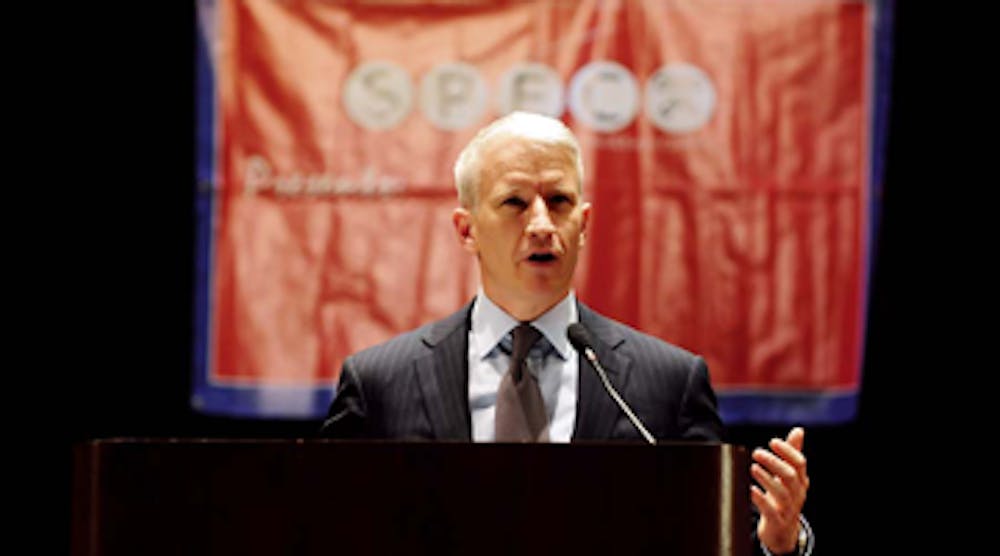
CNN host Anderson Cooper discusses the importance of objective journalism
· October 6, 2008, 5:00 am
Anderson Cooper, host of CNN's Anderson Cooper 360, spoke at Irvine Auditorium as the SPEC fall keynote speaker.
You may know him best as the Silver Fox. Or as the host of CNN's Anderson Cooper 360. But he prefers to be known simply as Anderson, a non-partisan news anchor who considers himself privileged to have his job - a job he did not know that he would want upon his 1989 graduation from Yale as a political science major.
For most of his life, Cooper had a keen interest in news. During his SPEC fall speaker keynote address on Saturday, he explained to a packed Irvine Auditorium that he decided to begin his career in journalism by "traveling to the most dangerous places on the planet." Savings in pocket and fake press pass in hand, he traveled to Burma, the first of the more than 50 countries he has visited as a reporter.
Besides covering stories live on the scene, Cooper is known for his discussion of hot political topics on his evening show, Anderson Cooper 360.
During his address, he discussed everything from his childhood as the son of socialite Gloria Vanderbilt to the many stories he has covered in his 15 years in the business.
According to Cooper, the best stories are "happening in real time. It's absolutely exhilarating. You know that you can make or break your career in a few sentences."
His advice to the audience was to "seek out what scares you the most." He told anecdotes about his personal intimidating situations, including diving with great white sharks and reporting from war-torn countries like Iraq and Somalia. He suggested "plunging head first into a career or any other aspect of life."
Despite the political saturation that being a CNN anchor brings him, Cooper maintains his non-partisanship, saying, "I'm not interested in opinion-based journalism. It just validates your own point of view."
And, when asked to name someone whose work he admires during the question and answer session, Cooper mentioned the writer Bob Simon, emphasizing that "the craft of writing is really important."
Co-director of Connaissance and College junior Eileen McKeown explained why SPEC chose Cooper: "He epitomizes what we look for in a speaker. . We brought him to campus because of his unique ability to capture the human side of news stories as he relays his inside perspective to the public."
The audience seemed to enjoy his presentation, offering a standing ovation as Cooper exited the stage.
As College junior Kate Shulman said, "Anderson - he insisted we call him by his first name - exemplifies the values and goals that seem to be missing in today's public personalities."
She added, "Not only did his adept writing skills and passion for truth and knowledge shine through, but also his humor and pleasant, unassuming demeanor captivated the students and faculty at Penn."


Comments (1)
Deborah Wadley
December 31, 1969, 7:00 pm
Flag this comment
I?m saddened to see that, as intelligent as the United States seems to be, we continue to disregard history. It is commonly acknowledged that an understanding of the past is fundamental to an understanding of the present. The analysis and interpretation of history provides an essential context for evaluating contemporary institutions, politics, and cultures. Understanding the present configuration of society is not the only reason to study the past; history also provides unique insight into human nature and human civilization. By demanding that we see the world through the eyes of others, that we develop a sense of context and coherence while recognizing complexity and ambiguity, and that we confront the record not only of human achievement but also of human failure, cruelty, and barbarity, the study of history provides us with a richly-textured, substantive framework for understanding the human condition and grappling with moral questions and problems. History is essential toward the quest for wisdom and virtue. We can refer back 65 million years ago to the late Cretaceous period. Or, as early as 476 A.D., when the Germanic general Odacer overthrew the last of the Roman Emperors, Augustulus Romulus. There were many reasons for the fall of both ?empires?; primarily the way each contributor managed the environments provided to them. While dinosaurs had great instincts to evolve and survive; they failed to adapt quickly enough to an ever-changing world. Thus, extinction was their fate. The Roman Empire, however, could have avoided their demise. Humans, unlike animals, were gifted with a brain that should be able to process and analyze facts, outcomes, data sets to evolve and formulate lessons learned to correct misguided directions before a foreseeable decline. The Roman Empire chose to participate in the decline in morals and values. Emperors like Nero and Caligula became infamous for wasting money on lavish parties. The most popular amusement was watching the gladiatorial combats in the Colosseum Ð attended by the poor, the rich, and frequently the emperor himself. One contest after another was staged Ð should the ground become too soaked with blood, it was covered over with a fresh layer of sand and the performance went on. The $700 billion bailout is the ?new layer of sand?. Urban decay was also a large contributor to the failing empire. Wealthy Romans lived in a domus, or house, with marble walls, floors with intricate colored tiles, and windows made of small panes of glass. Most Romans, however, were not rich. They lived in small smelly rooms in apartment houses with six or more stories called islands. Other contributors to the fallen Roman empire included public health (or the lack of); political corruption; unemployment; inflation; and military spending. All left Rome open to outside invaders. Rome was no more in the West. Yes, Italians still populate our great world. But contemplate, if you will, what would Rome be today had the people in power governed with integrity, honesty, trust, and most importantly, respect for the lives of the people they were empowered to make decisions for. Any of the above sound familiar? Have we not learned from the past? Are we destined to repeat what the Roman?s have already demonstrated won?t work? The ?empire? can not survive without a stable and strong working population. A population that contributes towards the good of the whole. Understanding that greed and corruption have already seeped into the many facets of our economy, a correction will take time. I urge you to stop adding a ?new layer of sand? to our decline. We have an opportunity to learn from other?s mistakes and manage this crisis with integrity and responsibility. History demonstrates, it?s imperative to effectively manage environments from the bottom Ð up. If you don?t, the top of the food chain will starve and crumble. When devising a plan, it is imperative that incentives are provided to individuals who have lived their lives with utmost respect for themselves as well as their families. Provide credit and incent those who chose to live within their financial means. Providing a bailout (or to rescue) those who chose greed and to speculate and spend beyond their financial portfolios will only incent continued corruption and greed. We need to strengthen our economy FROM THE BOTTOM UP. All the money in the world towards failing, corrupt companies and Wall Street will not provide a viable solution. Corrupt ?empires? will not pass on incentives to honorable consumers. You think it?s bad now, wait until the holidays when consumers (the people) have NO money to spend?.. LET?S THINK OUT OF THE BOX?. ~$85 billion in cost Ð do the math. Or, the Government can continue to encourage and support lavish corporate behavior. A home inspector will advise you that it is a bad decision to renovate a historical mansion on top of a crumbling foundation. The PEOPLE are our foundation. We need to stabilize from the bottom up or our economy will resemble the Leaning Tower of Pisa and the government will have resolved nothing. ?Give back? to the people who have been impacted and financially destroyed by corporate corruption and greed. Each US citizen (1040 taxpayer) 25 and over would receive $250,000 single -- $500,000 married filing joint. With this THE PEOPLE CAN CHOOSE HOW TO STIMULATE OUR ECONOMY ONCE AGAIN. 1.Pay off mortgage(s) and pay property taxes: Turning around the housing market; eliminating foreclosures; placing people back in their homes. The banks will benefit because they will receive the funds loaned to borrowers; local governments will benefit because individuals will be able to contribute to property taxes Ð stimulating the ?local? economy. This crisis is affecting all mortgages Ð not just individuals who purchased a home they couldn?t afford. November is just around the corner. If individuals can?t afford to pay their mortgage, do you think they will be able to pay their property tax bill? 2.Pay off debt: Credit cards, car loans, etc. Eliminating bankruptcy proceedings. 3.Bridge unemployment: For those who are losing their jobs due to greedy companies who thought of themselves vs. the whole. 4.Buy healthcare policies: Maybe some in this country may now be able to afford healthcare for themselves and their children Ð maybe even grandparents. 5.Contribute to their child?s ?private? education: College? 6.Contribute to a 401(k) or IRA: Placing money back into the ?banking? industry and saving for "our" future?. 7.Small business: Can continue to contribute to their local economies; fund their payrolls Ð avoiding layoffs. GIVE TO THE PEOPLE NOT THE CEO?S, COMPANYS, and WALL STREET. THEY WEREN?T ABLE TO MANAGE THE MILLIONS/BILLIONS THEY ALREADY HAD. America is on the brink of the worst financial crisis since the 1930s. Jobs, homes, prospects for higher education, and retirement savings of millions of Americans are at risk. Bond markets for necessary highway repairs and capital infrastructure remain vulnerable. Instead of crafting a measure that would restore stability to the economy; protecting US jobs, savings, and financial futures for ALL Americans, the Senate and House passed the Emergency Economic Stabilization Act. The Senate attached additional provisions to this bill that should have been considered on their own merits Ð essentially our ?leaders? transferred the ?golden parachute? from CEO?s to special interests. It was inappropriate for the Senate to add special provisions and other tax breaks targeted to niche industries. We must clean up our ?sand box? before we can continue to support others who have relied on us for help. If the US fails to demonstrate wisdom and strengthen within, our failure will be felt worldwide. Deborah Ann Wadley (916) 983-6666 Ð (916) 351-2207 Ð ldcwadley@msn.com
Comments are closed for this item.