

Student describes Thanksgiving's origins

· November 20, 2007, 5:00 am

Share This

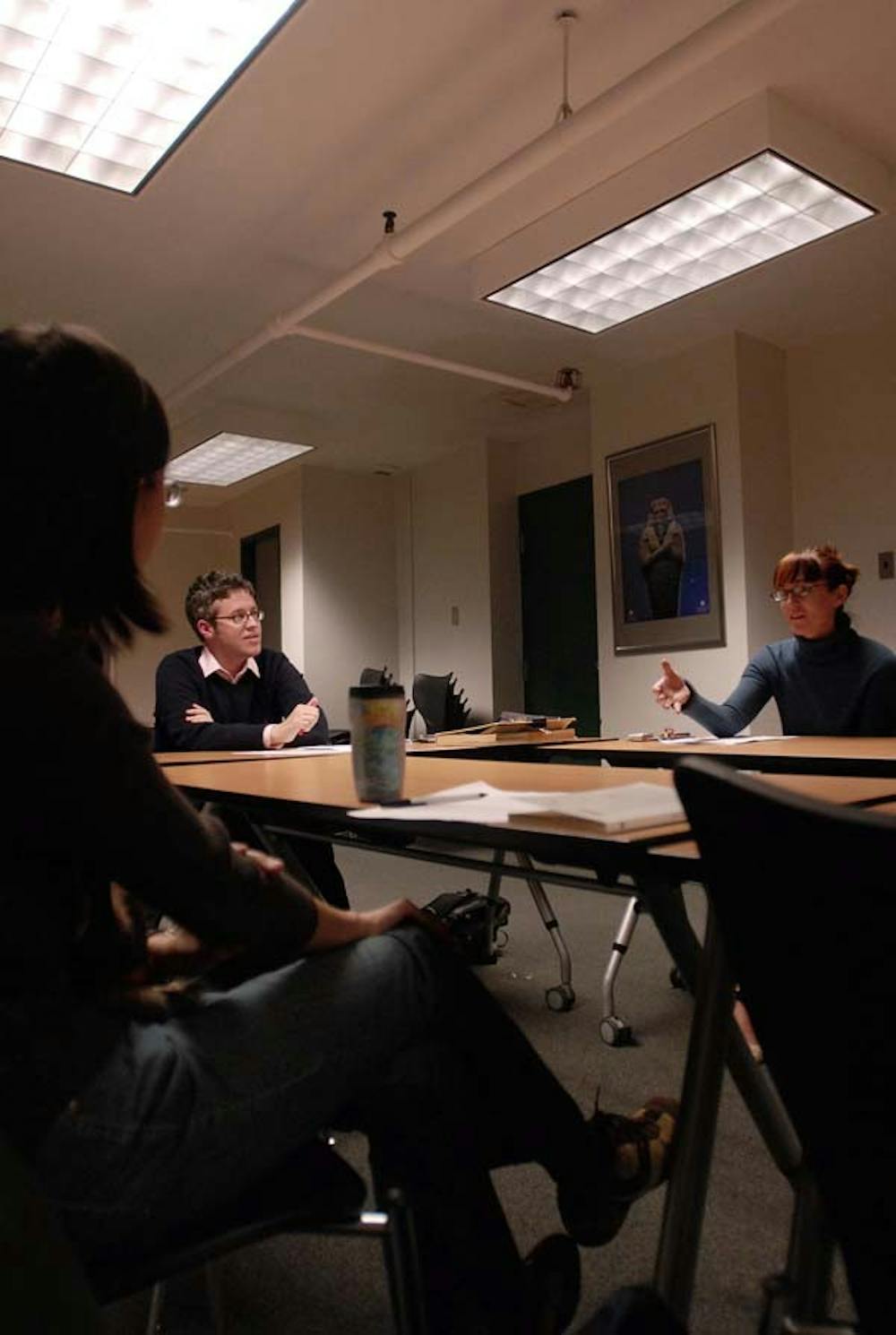
Ph.D. student Andrew Lipman, specializing in early American history, leads 'Thanksgiving 101,' a discussion on the history of the popular American holiday yesterday afternoon in the Graduate Student Center.


Family, food, Black Friday and traffic jams are just some of the things commonly affiliated with Thanksgiving.

Beyond that, though, the upcoming holiday has a long history dating back to the first American settlers.

Attendees of "Thanksgiving 101," a lecture held at the Graduate Student Center yesterday, learned about the historical origins of Thanksgiving and the facts and fictions behind the holiday.

Andrew Lipman, a Ph.D. student studying early American history, led the discussion.

According to Lipman, historical accounts reveal that there were 100 Pilgrims who set sail on the Mayflower from England to America - only 50 survived the journey.

With the help of the Wampanoag tribe, the Pilgrims were able to grow crops to sustain themselves, and to celebrate a successful fall harvest, the Wampanoag and Pilgrims had a three-day long feast in late September or October.

Lipman said the settlers and natives likely ate on the ground without forks and consumed foods such as turkey, deer, corn, codfish, mussels, cranberries and beer.

"It was much messier and boozier than what we all might think," Lipman said. "But most things in the Thanksgiving myth are, in fact, accurate. Squanto was a real person in the Wampanoag tribe. And they did have a large feast."

However, the first official Thanksgiving feast was not declared until 20 years later.

"Connecticut Puritans started the first Thanksgiving as sort of a fake Christmas since their religion forbade a Christmas celebration," Lipman said.

Abraham Lincoln declared Thanksgiving a national holiday in 1865.

According to Lipman, Lincoln's motive was to reunite the country in the midst of the Civil War and create a symbolic gesture before his reelection campaign.

In 1970, various Native American tribes united to make Thanksgiving a national day of mourning due to the high death rates of natives after the arrival of settlers.

In response to the controversy surrounding the holiday, Lipman said, "the way I deal with this information and still enjoy my pumpkin pie is to think of this holiday critically. I try to understand Thanksgiving as an artifact of American history and think of it in many layers."

A number of the attendees of Lipman's lecture were international students eager to learn about the history behind a uniquely American holiday.

"I attended it because I celebrated Thanksgiving a few times before and I was very curious to see what it was about," said international student Ann Ang, who is currently working toward her Master's in English.

Education grad student Yun-Hsiang Hung agreed.

"I learned a lot," Hung said. "I came to this lecture because I was curious and wanted to know about the history of Thanksgiving since we do not celebrate it in Taiwan."


Comments (4)

UFboy2006

December 31, 1969, 7:00 pm

Flag this comment

And wild turkey was never on the menu, it was fowl according to william bradford...it was duck or geese. So basically "thanksgiving" was duck/geese, corn, seafood, and fruits (history channel research also states seals and swan, yummy)....basically nothing like it is today lol. Also reading the accounts of ed winslow and will bradford obviously shows the indians were never invited, they just happened to be at the right place at the right time. Also their accounts really make it seem that their invitation to the Indians was also to show them that the white man was still superior. Go figure.

UFboy2006

December 31, 1969, 7:00 pm

Flag this comment

And wild turkey was never on the menu, it was fowl according to william bradford...it was duck or geese. So basically "thanksgiving" was duck/geese, corn, seafood, and fruits (history channel research also states seals and swan, yummy)....basically nothing like it is today lol. Also reading the accounts of ed winslow and will bradford obviously shows the indians were never invited, they just happened to be at the right place at the right time. Also their accounts really make it seem that their invitation to the Indians was also to show them that the white man was still superior. Go figure.

Bob Skilnik

December 31, 1969, 7:00 pm

Flag this comment

...the indians were never invited, they just happened to be at the right place at the right time. Imagine that. 90 unexpected guests drop in for the holiday. They did send out some young bucks who killed and brought back 5 deer, so it wasn't all bad. It could have been worse; imagine if they had brought back fruitcake.

Bob Skilnik

December 31, 1969, 7:00 pm

Flag this comment

Lipman said the settlers and natives likely ate on the ground without forks and consumed foods such as turkey, deer, corn, codfish, mussels, cranberries and beer. Mr. Lipman continues the fabled notion that beer was consumed at the Seperatists' first harvest festival. 4 primary souces are noted below, and none of them mention beer being consumed. Speculation, but no research is evident here in Lipman's interpretation. Bibiography Mourt's Relation Originally printed in 1622, this is the first published account of the coming of the Pilgrims to the New World to settle Plymouth Plantation. There are at least 5 different letter writers involved in this effort, but while much of what's in this book echoes the observation of William Bradford, there's a little bit to much enthusiasm in it, some attributing this cheery theme to Edward Winslow who also wrote... Good Newes from New England in 1624. This was one more effort by Winslow to paint the bright side of living in New England and served as an enticement to others to come on over the fun of living in New England, just a few years after half of the original settlers had died off. Historically, however, it's a primary source on everyday living in the New World. Of Plymouth Plantation One of a number of books from William Bradford, who led the original settlers after the death of their first governor, John Carver, in April 1621. A more clinical look at life in early Plymouth than Winslow's optimistic writings. Bradford also penned more recollections during his later years, including... Governor William Bradford's Letter Book Gathered during Plymouth Colony's crucial first decade, Bradford's Letter Book served as a sourcebook for the Governor's well-known history, "Of Plymouth Plantation." This intriguing set of letters and documents offers us valuable first-hand acquaintance with the leadership of New England's first plantation. From this collection, we can better appreciate the complex reality that lies behind our idealized image of "the Pilgrim Fathers." Here we can see the conflicting motives and internal struggles, the misunderstandings and misrepresentations, and the practical considerations which combined to shape the lives of the early Plymouth colonists.

Comments are closed for this item.