

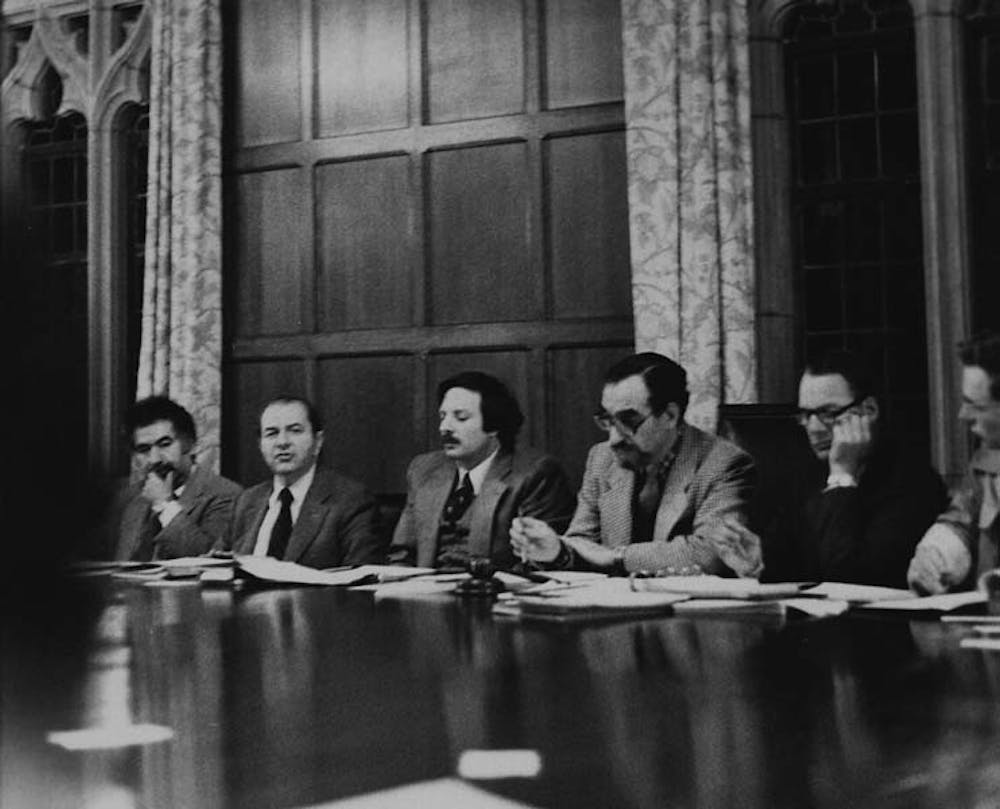
Martin Meyerson, Penn's sixth president, died of prostate cancer Saturday at Penn Presbyterian Medical Center.
He was 84.
Meyerson, who served as president from 1970 to 1981, saw Penn through a severe fiscal crisis and set about uniting a sometimes fractious faculty and student body, helping to lay the groundwork for the University's meteoric rise in prestige and in national college rankings under successors Sheldon Hackney and Judith Rodin.
Born in 1922, Meyerson started his academic life as an urban planner and received his bachelor's from Columbia University in 1942 and his master's in city and regional planning from Harvard University in 1949.
Beginning his career in academia at the University of Chicago, Meyerson went on to head three universities: He was acting chancellor of the University of California at Berkeley, president of the State University of New York at Buffalo and finally successor to Gaylord Harnwell at Penn.
Yet the University which Meyerson led is a much different institution than the one students and faculty know today.
Meyerson inherited a budget deficit from Harnwell that put the University in dire financial straights - the economic crisis of the 1970s conspired with the collapse of the Pennsylvania and New York Central Transportation Co., in which about a third of Penn's endowment was invested, to seriously threaten the University's financial stability.
His stable hand at the helm and prudent financial management, while not as immediately eye-catching as the building sprees sponsored by Hackney, Rodin and current President Amy Gutmann, were important in setting Penn up to compete with other major research universities.
That's not to say, however, that Penn faculty and students always agreed with his financial policies, which frequently led to programs being cut or scaled back - the most notable of which was Meyerson's decision to drop men's hockey as a varsity sport.
This and other actions "led to a series of sit-ins and confrontations," Hackney said.
However, in the end much of Meyerson's fiscal agenda was adopted as policy.
"He managed those kinds of challenges in a way that allowed him to close out his presidency on a high note," said Mark Frazier Lloyd, the University archivist.
But fiscal concerns weren't his only focus while president.
Meyerson also spent a great deal of time pushing his "One University" policy, in which connections between departments were strengthened and interdisciplinary scholarship was emphasized.
This commitment could be seen in his and his wife's commitment, even after Meyerson's tenure ended, to the University's libraries, said Carton Rogers, director of libraries.
"He knew that the library was Switzerland," a neutral body that should serve the entire Penn community, Rogers said.
But Meyerson's most visible accomplishment as president was his creation of the School of Arts and Sciences by consolidating the College for Women, the College of Arts and Sciences and graduate programs into one entity, demonstrating a commitment to the liberal arts core of Penn that had traditionally been neglected.
"Penn was always recognized as having great professional schools. . But the liberal arts core of the University suffered by comparison," Lloyd said, who credited the move as "the chief reason that Penn has advanced in the national academic standings."
Meyerson's other contributions to Penn include: the creation of College Green, the introduction of freshman seminars into the undergraduate curriculum, launching the University's first affirmative action program, laying the groundwork for the college-house system and increasing Penn's international ties and stature through his active leadership.
Outside his career at Penn, Meyerson was the author of five books and served on dozens of academic, cultural, corporate and philanthropic boards, including as chairman of the Institute of International Education, which administers the Fulbright fellowships.
While funeral services were held privately, Gutmann, in a statement, said that Penn was planning a memorial service in his honor for the fall.
Meyerson is survived by his wife of 61 years, Margy, two sons, Adama and Matthew, and seven grandchildren. His daughter, Laura, predeceased him.

